Case Study
Friction to Feedback: Designing a B2B2C Reputation Engine
My PM asked for an email link to a partner's outdated questionnaire. I designed something bigger instead: the whole loop — a 1-click email rating that routes happy users to a public review funnel and unhappy ones to a private recovery loop. My PM reviewed it and shipped the simpler original scope; this is the design I proposed.
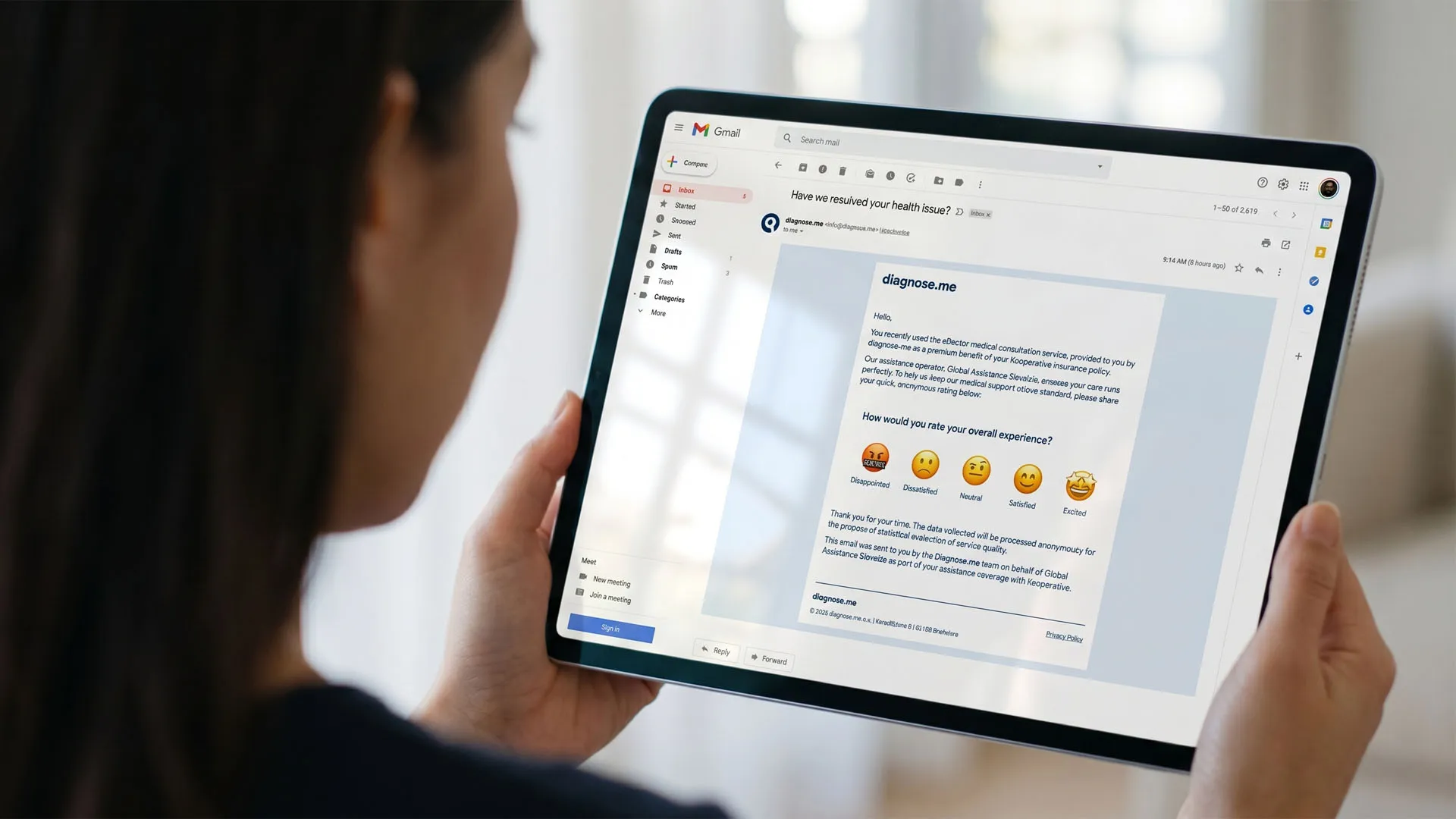
The Problem
A patient receives digital health services. Behind the scenes: three corporate entities — an insurance sponsor, the medical platform, and the integrator who contracts the platform on the sponsor’s behalf.
Our integrator (Global Assistance Slovakia) asked my PM to design an email linking to their existing questionnaire. Simple ask. The friction underneath it was massive.
Patients were abandoning the form mid-flow. Response rates were collapsing. The old questionnaire was built for car-breakdown technicians, not healthcare patients — it used roadside-assistance vocabulary and forced an 11-option NPS choice as the first interaction on mobile.
Friction Audit
The original form was built for car-breakdown technicians. It split users by NPS score (good or bad), but executed both paths poorly:
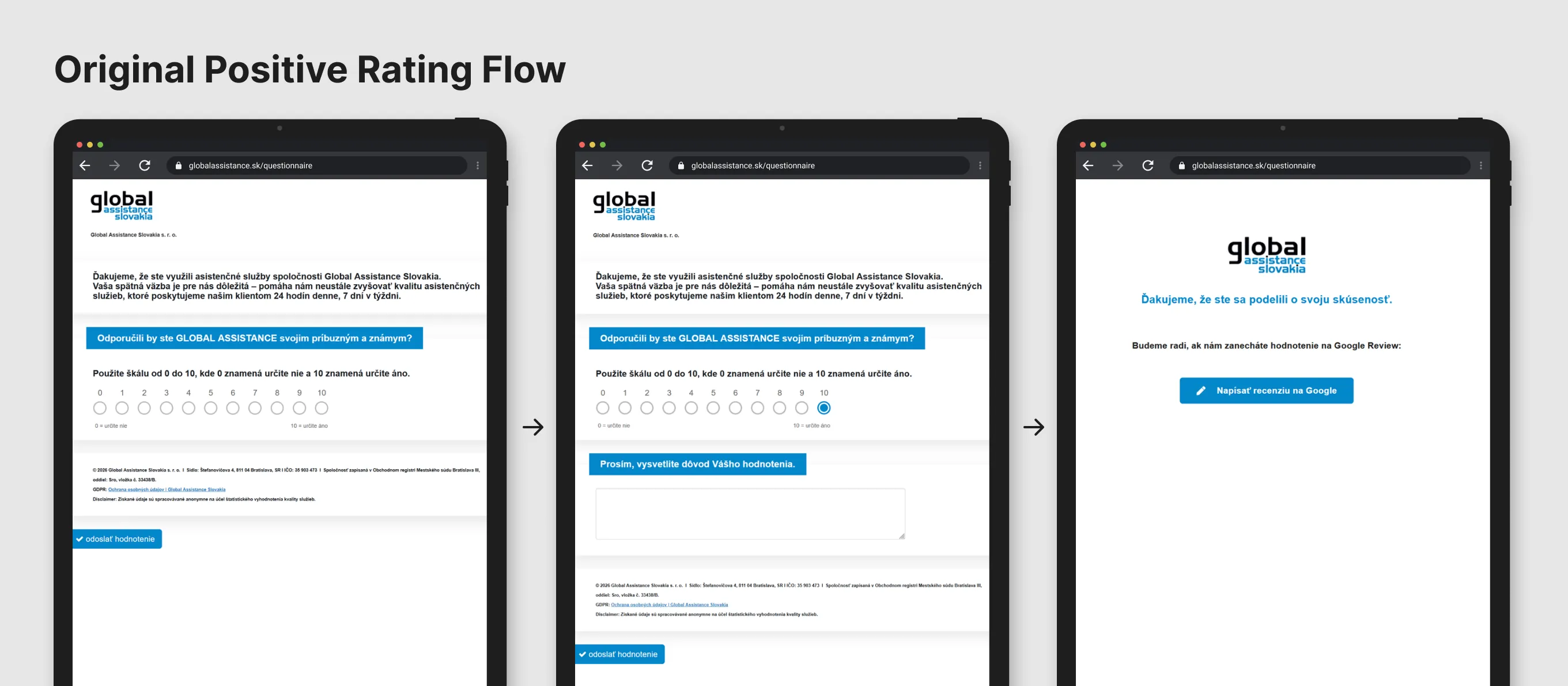
Positive path: 11-option NPS radio matrix + mandatory explanation field. Severe mobile drop-off.
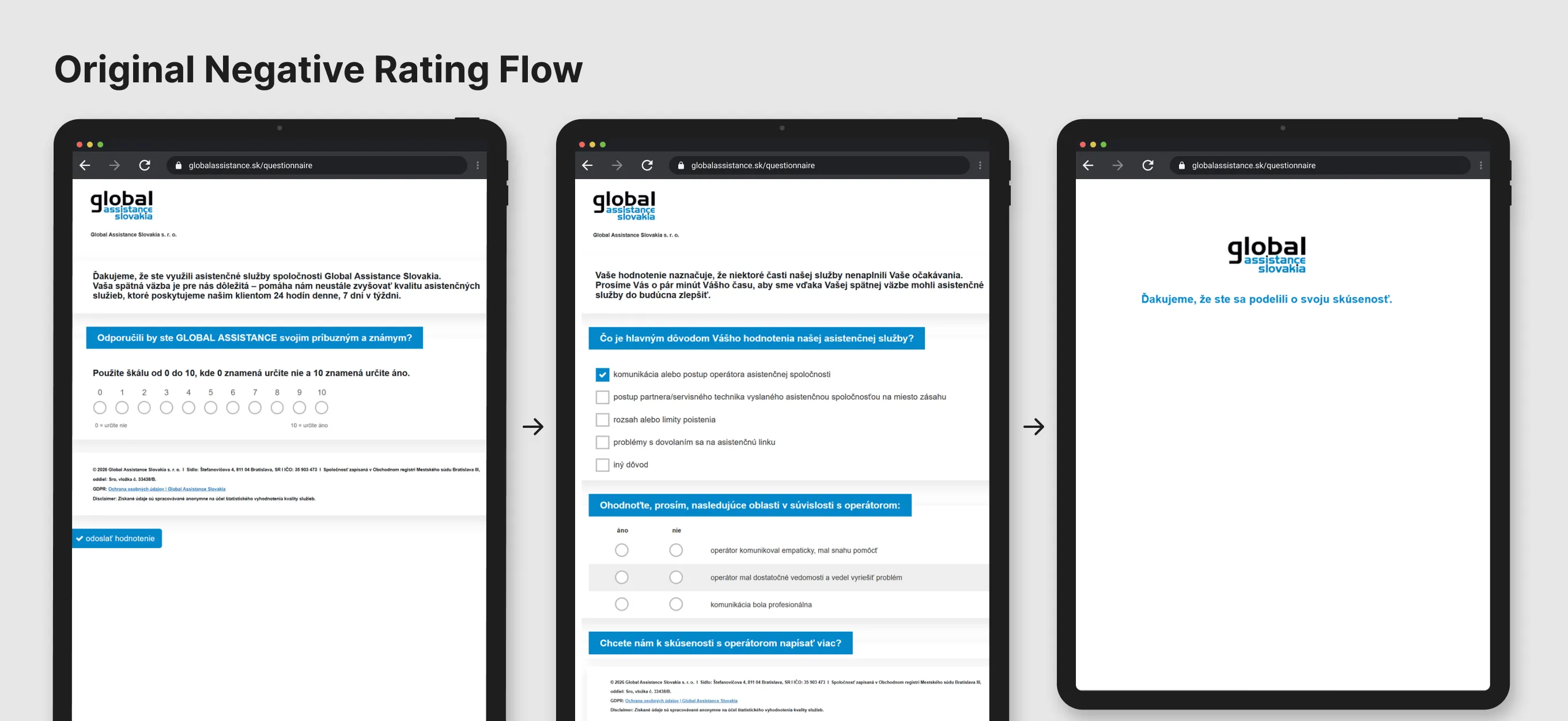
Negative path: Six checkboxes lumped together — operator complaints, medical feedback, logistics issues, all the same weight.
| Problem | Consequence | Solution |
|---|---|---|
| Roadside-assistance vocabulary in a medical context | Users confused by “technician” language, “policy limits” — wrong mental frame. | Healthcare-specific copy aligned with patient expectations. |
| Cognitive overload — 11-option NPS as first interaction | Response abandonment, especially on mobile. | 5-emoji scale (😞→😊) in the email body — one tap. |
| Friction-heavy inputs — text required upfront | Keystroke friction breaks mobile completion. | Tag pills for positive path (3-second taps), optional text for negative. |
Trust breakdown — unexpected jump to globalassistance.sk | Phishing anxiety kills response rate. | Email explains the partnership upfront; handoff-disclosure removes surprise. |
| Untethered operational data | Medical feedback tangled with operator complaints; no actionable separation. | Dual paths: public funnel for advocates, private recovery loop for complaints. |
Strategy: Decoupling Brand Responsibilities
The root cause: three corporate identities in one email with no role clarity. The user doesn’t know who’s asking what, so they freeze.
The fix: anchor each brand to a single role so the eye and trust both know what each logo means.
- Diagnose.me = Your doctor. The one providing medical care.
- Kooperativa = Your insurer. The one who sponsors this benefit.
- Global Assistance = The quality auditor. Independent, separate from the medical platform.
When GAS is framed as an operational reviewer — not a medical entity — the domain switch from diagnose.me to globalassistance.sk reads as a logical handoff, not a trap. The user’s trust doesn’t break because the roles are clear upfront.
The Solution: Two Core Innovations
Innovation 1: Move the Rating to the Email (1-Click Capture)
The form doesn’t start on a landing page — it starts in the inbox. A 5-emoji satisfaction scale replaces the 11-option NPS matrix, and the whole thing lives inline in the email body:
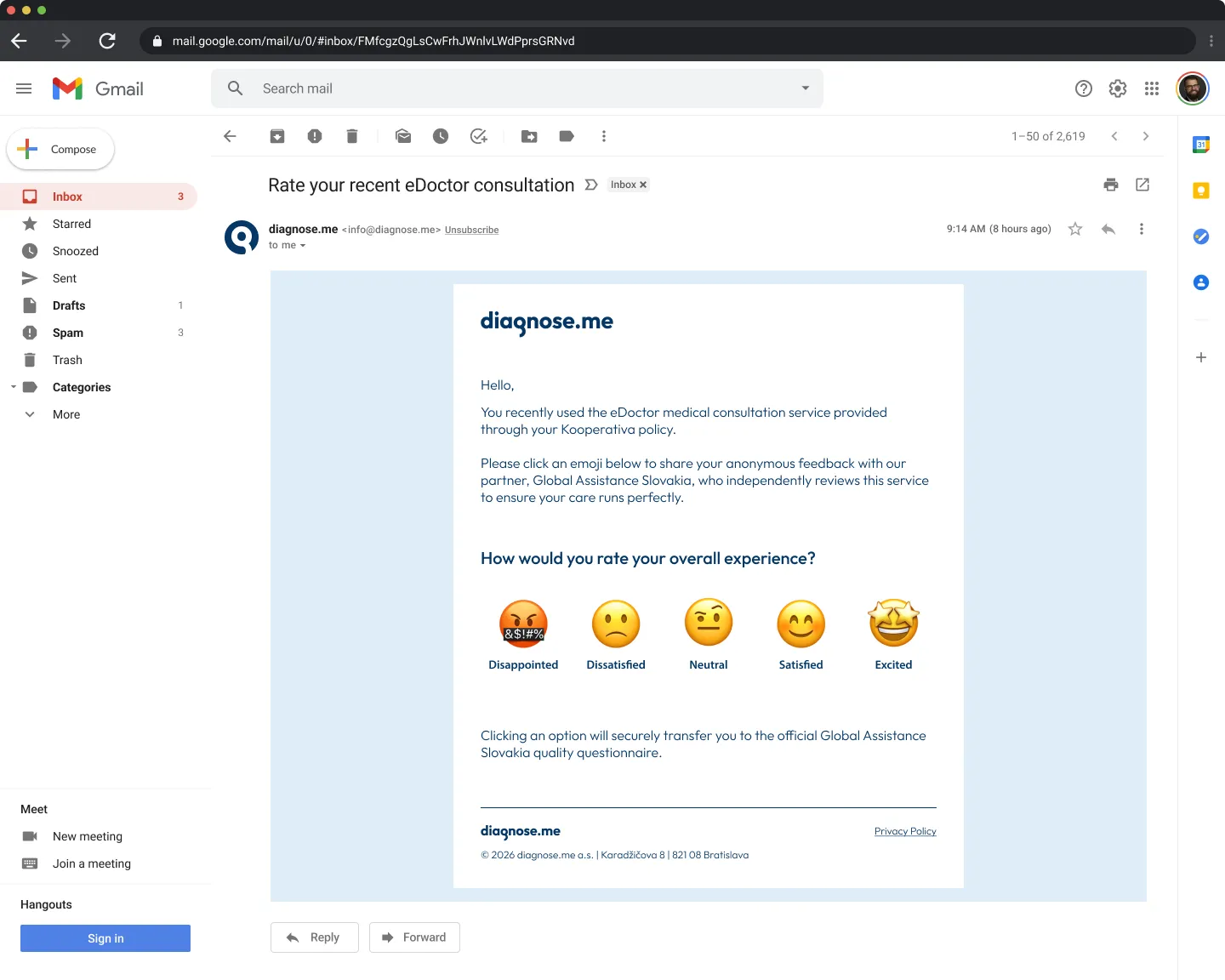
One tap in the inbox registers the rating. User never leaves email. Baseline data secured before any questionnaire.
Why it works:
- No landing page friction. The rating is instant.
- Bracketing copy does trust work upfront: “share your anonymous feedback with our partner… who independently reviews this service.”
- Handoff-disclosure line closes the domain-switch trust gap: “Clicking will securely transfer you to Global Assistance Slovakia’s quality questionnaire.”
- Even if the user drops off at the questionnaire, the rating is captured.
Innovation 2: Route Based on the Rating (Dual-Path Optimization)
The emoji a user tapped determines which questionnaire they see next. Same URL, opposite goals:
Happy users (4–5 stars) → Public marketing funnel Unhappy users (1–2 stars) → Private recovery loop
Path A: Advocates to Google Reviews (4–5 Stars)
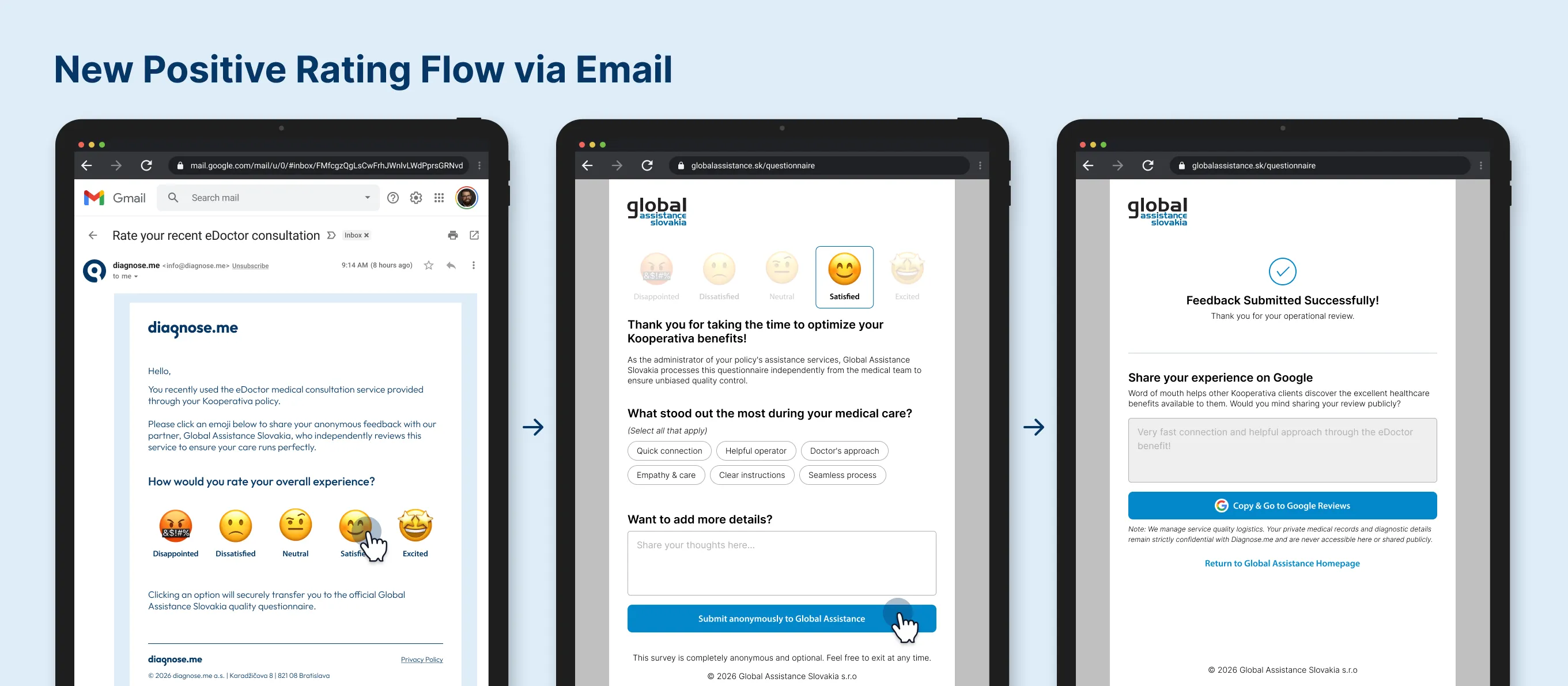
The three moves:
- Tag pills instead of open text. “Quick connection,” “Doctor’s approach,” “Helpful operator” — scannable, tappable in 3 seconds. Kills the keystroke friction.
- Clipboard bridge to Google Reviews. The exit screen auto-copies the user’s feedback. A single “Copy & Go to Google Reviews” button sends them to review. One tap. Marketing payload delivered.
- Privacy statement baked in. Fine print: “We manage service quality logistics. Your medical records remain strictly confidential with Diagnose.me and are never shared publicly.” Medical data stays protected; reputation builds publicly.
Path B: Unhappy Users to Recovery (1–2 Stars)
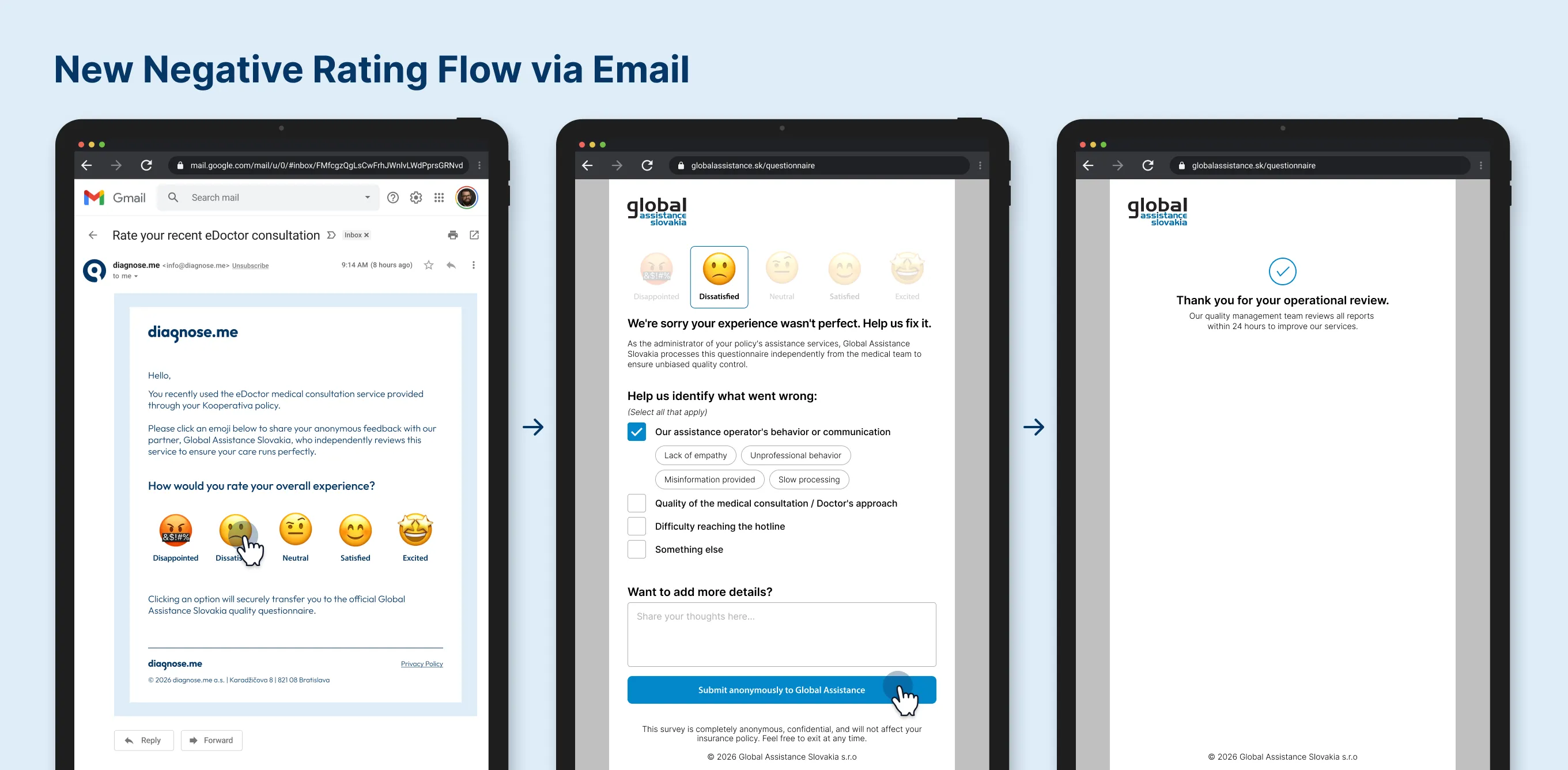
The three moves:
- Tone shift on first impression. Headline changes to: “We’re sorry your experience wasn’t perfect. Help us fix it.” Empathy first. No public marketing CTA anywhere.
- Operator complaints isolated from medical feedback. Checkboxes separate hotline/operator issues from platform feedback. GAS gets actionable operational metrics; Diagnose.me’s medical reputation doesn’t sink with call-center complaints.
- Anti-retaliation + accountability. Fine print: “Completely anonymous, confidential, will not affect your insurance policy.” Exit screen promises: “Our quality team reviews all reports within 24 hours.” Closes the loop with reassurance, not silence.
Impact & What Actually Shipped
My PM reviewed the design and chose to ship the original scope: a simple email link to the existing questionnaire. This is the bigger system I proposed — and it didn’t launch.
But that’s not the story here.
This case study shows what product thinking looks like when you spend 3 days in a real constraint: three corporate entities, competing incentives, users abandoning mid-flow, and a brief that felt simple until you audit the friction.
The design demonstrates:
| What I spotted | Design leverage | Business outcome |
|---|---|---|
| Entry friction kills response. Users abandoning on a 11-option NPS scale. | Move the rating to email (1-click emoji). Capture baseline before questionnaire. | Response rate decoupled from form completion friction. |
| Trust breaks at domain switch. Phishing anxiety when users jump from diagnose.me to globalassistance.sk. | Bracket the rating with partnership framing + handoff disclosure. Explain why GAS is asking. | Domain switch reads as intro, not trap. Trust maintained. |
| Operational and medical data tangled. Same form fields mix call-center complaints with medical feedback — no separation. | Dual-path routing: public for happy, private for unhappy. Isolate operator issues from platform issues. | GAS gets operational metrics for coaching. Diagnose.me’s medical reputation untangled from logistics. Each entity gets what they need. |
| Retaliation chilling effect. Users afraid to complain about a sponsor-funded service. | Anonymous + confidential + “won’t affect your policy” stated explicitly. | Users trust the form is safe. Negative feedback captured, not suppressed. |
This is the kind of work I’d bring to a product team: reading the constraint, auditing the real friction, and designing the system that serves multiple stakeholders at once.
More projects

This Site Is the Case Study: Designed, Directed, Measured
My one genuine 0→1, owned end to end: strategy, IA, UI direction, an AI-directed build, launch — then Clarity session data driving a measured iteration. I'm a UI/UX designer, not a developer. This live site is the proof.
Scaling a Returns Loop Across Rural Markets
I was asked to hide a courier option in small print to protect margins. Instead, I designed location-aware routing to serve every customer ethically without breaking unit economics. A self-directed concept built from real constraint.